


Why Content Writing AI Matters Now
If you’re a blogger, marketer, or small business owner, you’ve likely tried an ai content writer or at least heard about it. Tools similar to ChatGPT are everywhere, and the best ai content writing tools can help you research, outline, and draft faster. But not all tools are equal, and not all are beginner-friendly.
General-purpose chatbots are powerful. Yet specialized writing assistant software takes it further with templates, brand voice, and SEO features. Think of these tools as helpers that reduce busywork so you can focus on strategy, examples, and stories. This guide breaks down the top options, compares their strengths, and shows you simple steps to get useful, trustworthy drafts. You’ll see where AI fits, where human editing is essential, and how to avoid common mistakes like keyword stuffing or skipping sources.
What Is a Content Writing AI Tool?
A content writing ai tool is software that uses AI to help you plan, draft, and edit text. It can produce blog posts, outlines, product descriptions, social captions, emails, and more. You give it a prompt (instructions). It returns a draft that you can refine.
At the core is a large language model (LLM), a transformer-based model trained on text. The better your prompt engineering (clear instructions, examples, tone), the better the output. These tools also include content templates, tone of voice control, and sometimes SEO features like suggested headings, internal links, or on-page tips.
Benefits and limits:
- Benefits: Speed, structure, and creativity. Great for brainstorming ideas, building an outline, and getting a first draft.
- Limits: AI can “hallucinate” facts or create generic content. You still need human-in-the-loop editing, actual sources, and brand-specific insights to meet E-E-A-T and avoid thin content.
How to Choose the Best Writing Assistant Software
Use this checklist to pick wisely. Start simple. Add advanced features as you grow.
Output quality and factuality
- Can it follow a brief with clear, on-topic writing?
- Does it reduce hallucinations when you add sources?
- Does it support citations or source reminders to maintain originality and trust?
Long-form features (outlining and section writing)
- Does it have an AI outline generator and section-by-section drafting?
- Can you lock headings and ask AI to write under them to improve readability and skimmability?
SEO support
- Look for a content brief generator, keyword clustering tool, and a simple SERP analysis tool.
- Basic on-page SEO writer features help with headings, internal links, and meta tags.
Brand voice and style
- Can you define tone (friendly, expert, concise)?
- Does it learn your brand voice or offer guardrails for consistency?
Collaboration and workflow
- Comments, approvals, version history, role-based permissions.
- Export to Google Docs or CMS to fit your AI content workflow.
Templates and use cases
- Blog posts, web pages, ads, emails, FAQs, meta descriptions.
- An AI article writer and AI blog post generator save time for beginners.
Integrations
- Google Docs, WordPress, popular CMS platforms.
- Browser extensions for quick drafting and an AI rewriting tool for edits.
Pricing and limits
- Understand word limits, seat limits, and credits.
- Test with a trial before committing.
- Data privacy and compliance
- Check how your data is used and stored.
- Ensure compliance with your industry or region.
The Top 5 Content Writing AI Tools (2025)
We’ve evaluated market relevance, beginner experience, SEO features, and workflow fit. Below are five strong options similar to ChatGPT but designed for content creation.
Jasper
Jasper is a popular writing assistant software known for templates, brand voice options, and team features. Creators and marketers use it to draft blogs, landing pages, emails, and ads faster without starting from a blank page.

Benefits & Features
For beginners, Jasper’s templates guide you through prompts step-by-step. You can pick a format (blog post, product copy, email), define tone, and generate an outline before drafting. This helps you learn how to brief an AI article writer while keeping control over structure and voice.
On the SEO side, Jasper supports planning with headings and meta elements, making it useful as part of ai content writing tools. Its workflow plays well with creative teams who want drafts they can refine, edit for factual accuracy, and enrich with examples, sources, and internal links.
Pros:
- Robust template library reduces blank-page anxiety. You choose a format and Jasper guides inputs so beginners can produce structured drafts without getting stuck.
- Outline-first flow helps you lock headings and write under them. This improves readability and skimmability and keeps sections on-topic.
- Clear tone and brand voice controls make outputs more consistent across articles, emails, and landing pages.
- Built-in rewrite/expand/shorten tools act like an AI rewriting tool, so you can fix clunky sentences, tighten intros, and smooth transitions quickly.
- Good multi-format support (blogs, emails, ads, pages) lets you keep a single process for most day-to-day marketing copy.
- Collaboration-friendly workflow: teammates can review, comment, and iterate on drafts without switching tools.
- Helpful for meta elements (titles and descriptions). It speeds up basic on-page tasks during your editorial checklist.
- Gentle learning curve for non-technical users who want a guided way to produce decent first drafts.
Cons:
- Generic outputs if briefs are vague. Without audience, angle, and examples, drafts can feel samey and surface-level.
- Factual accuracy and hallucinations still require manual verification especially for stats, dates, and claims. Add citations and links.
- SEO planning depth is limited versus dedicated tools; you’ll likely still need keyword research, SERP analysis, and clustering elsewhere.
- Template rigidity can show through. Overuse may produce “AI voice.” Use brand examples and stories to humanize.
- Costs can rise with higher usage or more seats. Confirm word limits, credit policies, and team pricing before scaling.
- Requires prompt discipline. You’ll get much better results if you define intent, headings, and tone up front.
Copy.ai
Copy.ai focuses on fast ideation and drafting for blogs, social content, and marketing campaigns. It’s known for quick turnaround and straightforward prompts that help beginners get moving.
Benefits & Features
Copy.ai offers starter prompts that help you produce outlines, intros, and section drafts in minutes. It’s especially friendly for social content and short-form copy, but can handle longer posts by writing section-by-section with your guidance.
From an SEO perspective, Copy.ai supports clear headings, meta elements, and simple optimization steps, making it useful among ai content writer tools. You can build a repeatable process: brief, outline, draft, polish. It plays well with human edits and external SEO steps like internal linking and schema.
Pros:
- Excellent for fast ideation. It generates angles, headlines, hooks, and intro options quickly, which speeds creative brainstorming.
- Very simple UI with low setup time. New teammates can jump in, follow prompts, and produce drafts with minimal training.
- Strong at short and mid-length formats (social, emails, product blurbs) and can extend to blog sections when you supply a solid outline.
- Variant generation makes it easy to compare different tones and calls to action, supporting lightweight A/B testing.
- Good at punchy copy. If your writing needs energy or tighter phrasing, it’s helpful for line edits and punch-ups.
- Section-by-section drafting works well. Give it one H2/H3 at a time to maintain structure and reduce drift.
- Handy rewriting/paraphrasing to improve clarity, reduce repetition, or adapt the voice for different audiences.
Pros and Cons (expanded)
Cons:
- Long-form cohesion needs careful guidance. Without a strong outline and transitions, sections can feel disconnected.
- Repetitive phrasing can creep in. You’ll need to rewrite or vary sentence structures during final edits.
- Limited deep SEO support. You’ll still want a content brief generator and SERP analysis tool outside the platform.
- Fact-checking is still on you. Add sources and examples to raise trust signals and meet E-E-A-T expectations.
- Brand voice may wobble across pieces unless you give clear tone rules and examples up front.
- Exports and formatting may require manual cleanup to match your CMS styles.
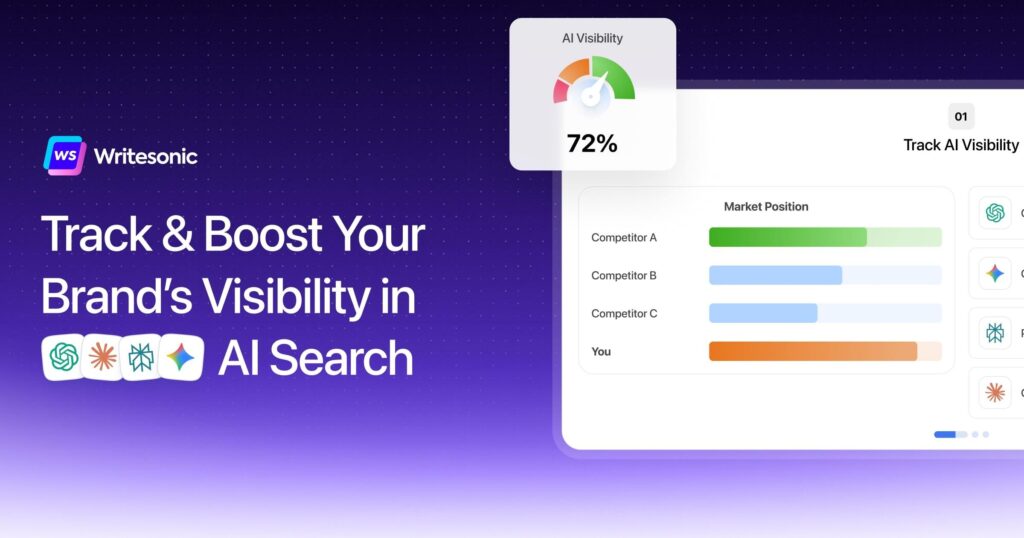
Writesonic
Writesonic is a user-friendly platform with a solid AI blog post generator and tools for landing pages, ads, and product copy. It suits creators who want long-form help with less friction.
Benefits & Features
Writesonic shines for long-form drafting. You can build a clear outline, expand sections, and adjust tone to match your brand voice. It’s helpful for beginners who want a guided process and quick editing passes, including rephrasing and shortening.
For SEO support, Writesonic helps with headings, meta descriptions, and basic on-page guidance as part of content writing ai. It integrates into a simple AI content workflow: plan the brief, generate an outline, draft section by section, and then optimize and fact-check.
Pros:
- Strong long-form experience. The outline → section writing flow is clear, so beginners can create structured drafts without getting lost.
- Granular control over tone and length helps you target the desired depth and style for each section.
- Effective rewrite, summarize, and expand tools to refine rough passages and make dense paragraphs easier to read.
- Covers a wide range of formats (blogs, landing pages, product descriptions), letting you standardize your process.
- Helpful for on-page basics like headings and an AI meta description generator, which saves time near publish.
- UI is straightforward and step-based, which simplifies training for new users and reduces friction.
- Supports a repeatable AI content workflow: brief → outline → draft → polish → optimize → publish.
- Encourages structured subheadings that improve readability and help your content align with search intent.
Cons:
- Hallucinations happen if you don’t supply facts or sources. Plan a fact-checking pass and add citations.
- SEO suggestions are basic. For keyword clustering and SERP analysis, you’ll likely pair it with an external SEO content assistant.
Overuse of “expand” can inflate word count without adding value. - Guard against fluff by locking specific talking points.
- Style can lean generic on niche topics. Add brand anecdotes, data, and quotes to differentiate.
- Section outputs may vary in tone or depth; an editorial pass is needed to standardize flow.
- Localization and domain nuance may be off. Adjust examples and phrasing for your audience and region.
Anyword
Anyword is aimed at marketers who want data-driven writing. It supports multiple channels—ads, emails, product pages—and provides guidance to keep messages on-brand and effective.

Benefits & Features
Anyword’s strength is structured, channel-specific drafting and controls for tone and voice. Beginners can use clear templates to set goals and audiences, then generate variants to test different angles.
For SEO and performance, Anyword fits workflows that value consistency and measurable outcomes, placing it among useful ai tools for content writing. It supports meta elements and structured drafts that are easier to optimize for search and conversion, especially when you pair outputs with internal links and references.
Pros:
- Channel-specific templates help align copy with platform norms (ads vs. emails vs. product pages), reducing guesswork.
- Strong emphasis on tone control and brand consistency, so your campaigns feel unified across channels.
- Variant generation supports message testing—useful for headlines, CTAs, and hooks when you’re optimizing conversions.
- Practical guardrails for marketing goals. It nudges you to clarify audience, intent, and value props before drafting.
- Helpful for ecommerce: product descriptions, benefit bullets, and social ads that need crisp messaging.
- Encourages structured outputs that are easier to adapt into meta titles, descriptions, and snippets.
- Speeds collaborative campaign work where teams need many versions and fast iteration.
Cons:
- Not the most robust option for deep, research-driven long-form blog posts compared with tools focused on blogging workflows.
- More settings and controls can feel heavy at first; plan a short onboarding to set voice and goals.
- Any “performance” guidance is directional, not a promise. You still need real-world tests and analytics.
- You’ll still do SEO research elsewhere (keywords, SERP gaps, internal linking plan) before writing.
- Factual accuracy is not automatic—verify claims, add sources, and cite original data when possible.
- Brand voice setup takes time. Expect to refine prompts and examples across your first few projects.
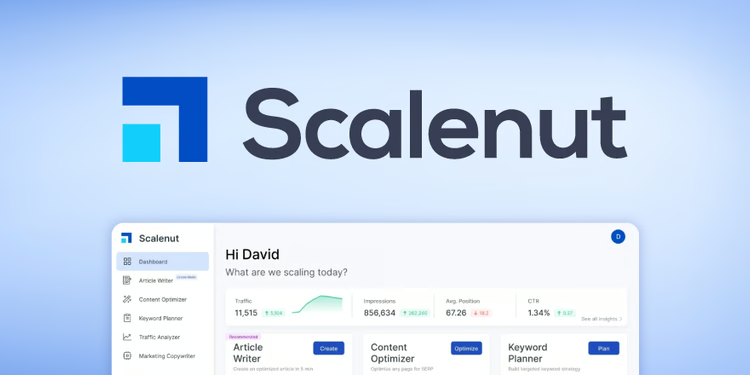
Scalenut
Scalenut blends AI writing with an SEO-focused workflow—briefs, outlines, keyword planning, and optimization. It’s designed for people who want a built-in SEO content assistant rather than piecing together multiple tools.
Benefits & Features
Scalenut helps you generate SERP-aware content briefs and outlines. Beginners can follow a guided process: find topics, map keywords, and then write drafts using templates for H2/H3s and sections. This keeps your content targeted and easier to edit.
On-page SEO features and keyword planning make Scalenut a compelling content writing ai tool for search-driven teams. It supports a steady workflow: research → brief → outline → draft → optimize, which reduces the chance of missing important subtopics or internal links.
Pros:
- SEO-first workflow guides you from topic research to content briefs, outlines, and optimization, reducing guesswork.
- Keyword clustering and brief creation help you cover related subtopics and match search intent more reliably.
- Structured outlines keep sections focused and skimmable, making long-form articles easier to write and edit.
- On-page optimization guidance can surface missing angles, questions, or headers to improve topical depth.
- Useful for building topic clusters and editorial calendars, which supports topic authority over time.
- Helps you operationalize SEO content guidelines for a team—repeatable steps and consistent deliverables.
- Reduces risk of content gaps by mapping headings to SERP findings and People Also Ask themes.
- Encourages a quality control process (brief → draft → optimize) that pairs well with human-in-the-loop editing.
Cons:
- More process-heavy than simple “draft now” tools. If you need quick copy, the workflow may feel slow.
- Beginners may need training to get the most from briefs, clustering, and optimization hints.
- Over-optimization is a risk. Resist keyword stuffing; write naturally and prioritize clarity and value.
- You still need unique research, examples, and citations to avoid generic outputs and support E-E-A-T.
- Template structure can feel rigid for creative formats; adjust outlines to keep your brand voice lively.
SEO data ages. Always verify recommendations and refresh briefs for fast-moving topics.
Comparison Table: AI Tools for Content Writing
| Tool | Best For | Key SEO Features | Collaboration | Pricing Snapshot | Learning Curve |
|---|---|---|---|---|---|
| Jasper | Templates, tone control, multi-format content | Headings/meta guidance, basic on-page | Team features, workflows | Plans vary; verify on site | Easy–Moderate |
| Copy.ai | Fast ideation, social/email + blog sections | Headings/meta, brief-to-draft flow | Simple sharing/export | Free/paid options; verify | Easy |
| Writesonic | Long-form drafting with outline-first workflow | On-page basics, meta descriptions | Export-friendly | Free/paid options; verify | Easy–Moderate |
| Anyword | Channel-specific, on-brand, testable copy | Structured drafts, meta support | Team + variants | Plans vary; verify on site | Moderate |
| Scalenut | SEO planning: briefs, clusters, optimization | Briefs, clusters, on-page optimization | Team workflows | Plans vary; verify on site | Moderate |
Note: Pricing and features change. Always verify on the vendor site
Conclusion
AI can make content creation faster, but success comes from a simple, repeatable process. For most beginners, Jasper and Copy.ai are easy starting points. If you want long-form structure, Writesonic is a strong pick. If you need research and planning in one place, Scalenut delivers. Data-driven marketers may prefer Anyword for consistent, on-brand copy across channels.
Remember: the best ai content writing tools are not “write and publish.” They are “co-create and improve.” Write a clear brief, give examples, add your voice, and verify facts and links before publishing. Bookmark this guide, share it with your team, and build a workflow you can trust.